Buying Guides
Spa Breaks Europe: 8 Destinations and Their Real Rules
By the Carefree Retreat team
Updated 2026
The difference between a great and a mortifying spa break in Europe is rarely the hotel. It is that spa breaks across Europe run on rules British visitors do not expect: in most of Germany, Austria and Slovenia the sauna is textile-free and a swimming costume is not merely optional but banned; in Iceland you shower without one before you go anywhere near the water; in a Czech spa town the point of the visit is drinking the water, not sitting in it.
Get that straight first and the rest is choosing between three genuinely different kinds of trip. Here are the eight destinations worth the flight, what each one actually is, and the etiquette that goes with it.
First, the three kinds of European spa break
Thermal bath cities. Public bathing complexes fed by natural hot springs, in a city you can also sightsee. Budapest is the obvious one. Good value, sociable, and not remotely a hotel-spa experience.
Sauna and thermal palaces. Enormous purpose-built complexes, mostly German-speaking Europe, built around dozens of saunas with rituals run to a timetable. Efficient, unfussy, and textile-free in the sauna areas without exception.
Cure towns and destination resorts. Karlovy Vary, Baden-Baden, the Slovenian termes, the Italian thermal resorts. Historic, medicalised in origin, and the closest thing to what a British visitor pictures when they hear “spa break”.
Which you want depends on whether you are going to be relaxed, entertained or treated. They do not substitute for each other.
1. Budapest, Hungary
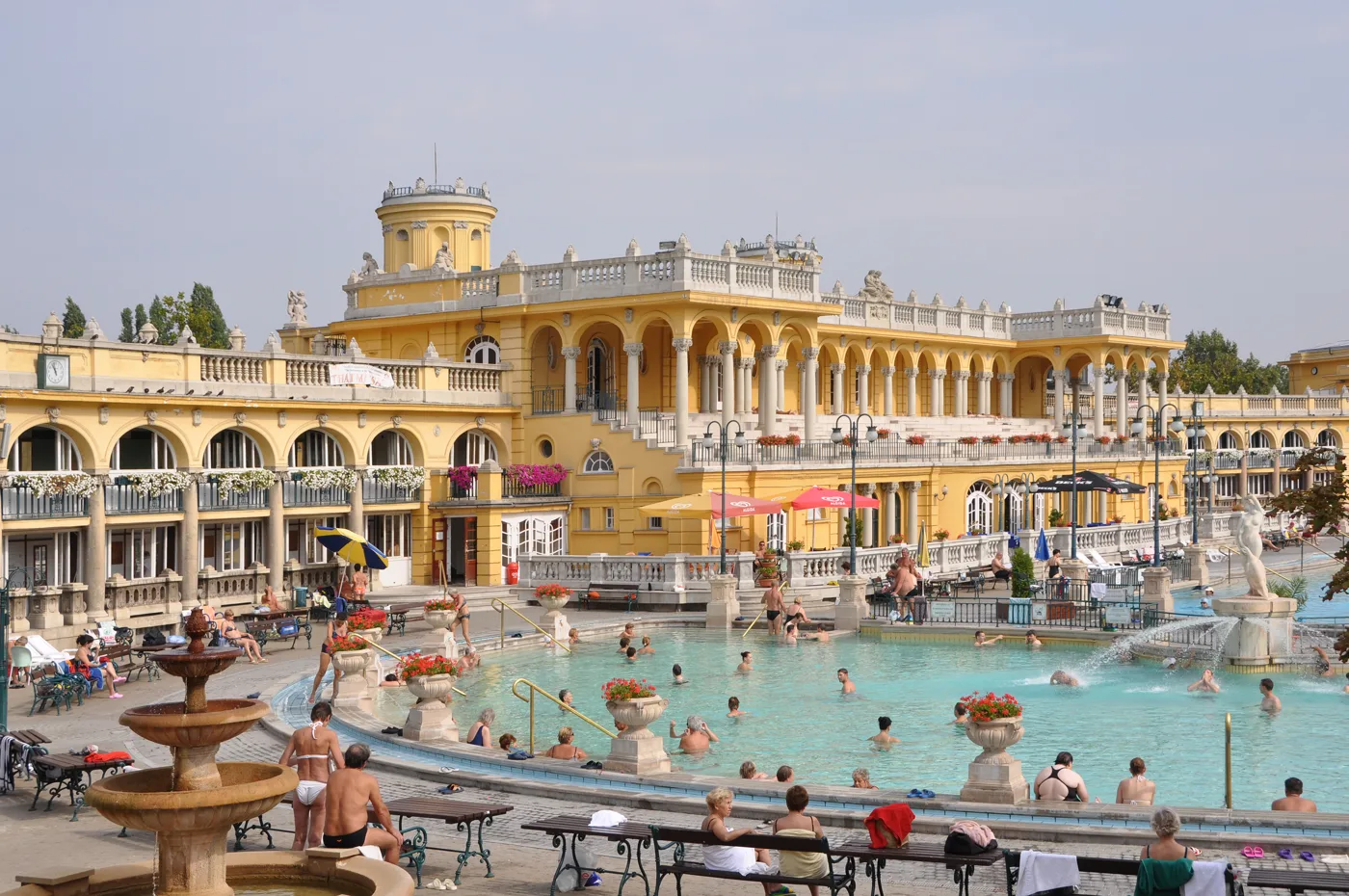
The best-value thermal city in Europe and the one to try first. Széchenyi is the postcard: vast neo-baroque courtyards, outdoor pools warm enough to sit in through a Hungarian winter, chess players in the water. Gellért is the more beautiful building, all art nouveau tiling and stained glass, and it feels calmer.
Practicalities that matter. Take flip-flops and your own towel or expect to hire one. The outdoor pools are swimsuit areas; the sauna and steam sections may not be, and rules differ between baths, so read the signs at the entrance to each section rather than assuming. Weekday mornings are quiet, weekend afternoons are not.
2. Therme Erding, Germany
Forty kilometres from Munich, and the largest thermal spa in the world. The scale is genuinely hard to picture: around 185,000 square metres, roughly 30 saunas across what is the largest sauna complex anywhere at about 12,900 square metres, plus a separate water park with 28 slides and a wave pool. Their own site lays out the zones.
The important structural point for anyone travelling with family: it is divided into a textile family area and adults-only zones from 16 upwards. The sauna world is textile-free. You take a large towel to sit on and wrap yourself in between saunas, and nobody looks at anybody. If you have never done a German sauna day, this is the least intimidating place to start precisely because it is so big that you are anonymous.
Ask about the Aufguss timetable when you arrive. These are the sauna rituals where an attendant pours infusions on the stones and works the heat around with a towel, and they are the reason people come.
3. Baden-Baden, Germany
The grand old spa town of the Black Forest, and the one with the strongest sense of ceremony. The Friedrichsbad’s Roman-Irish bath is a fixed sequence of showers, hot rooms, brush massage, baths and a wrapped rest at the end, walked in a set order over a couple of hours. It is textile-free throughout, with a schedule that varies between mixed and separated days, so check the current arrangement before you book anything else around it.
Next door, the Caracalla Therme is the swimsuit-on option, with its own textile-free sauna section upstairs. That pairing makes Baden-Baden a good choice for a couple where one of you is enthusiastic about the whole nude business and one is emphatically not.
4. Iceland: Blue Lagoon and Sky Lagoon
Iceland is the one where the rule British visitors most reliably break. Swimwear is compulsory in the water, and you must shower thoroughly without it, in the open communal showers, before entering. This is a public health norm rather than a suggestion, and it is enforced. Sky Lagoon sets it out plainly.
Of the two, Sky Lagoon is minutes from Reykjavík with an ocean horizon and a seven-step ritual, while the Blue Lagoon is the larger, more famous, more heavily booked lava-field original nearer the airport. Both cap numbers and both require booking a time slot well in advance; neither is a place you turn up at.
Also worth knowing: leave the silver jewellery at home. The mineral content of the water discolours it, and long hair takes conditioner and patience afterwards.
5. Slovenia’s termes
The most underrated spa country in Europe: a cluster of thermal resorts across the northeast, with natural mineral water, proper medical wellness alongside the leisure pools, and prices well below Austria or Italy for a similar standard. Easy to combine with Ljubljana or Lake Bled, which makes it the best value week-long option on this list.
Same sauna rule as the German-speaking countries. The sauna area is textile-free for hygiene reasons and swimming costumes are not permitted inside; you are given a sheet or towel to wrap in between rounds.
6. Karlovy Vary and the Czech spa triangle
Do not book Karlovy Vary expecting to spend the week in a pool. The Czech spa tradition is a drinking cure: you buy a porcelain cup with a spout, walk the colonnades, and drink from a series of springs at prescribed temperatures and mineral contents, with the bathing and treatments arranged around a stay of a week or more.
Understood on its own terms it is a lovely, unhurried and very European kind of holiday, with grand nineteenth-century architecture and forest walks. Understood as a hotel spa it is a disappointment. Saunas here are typically nude; pools require a swimming costume.
7. Italian thermal resorts
Tuscany’s thermal springs, the volcanic waters of Ischia and the Euganean Hills near Padua are the mainstream Italian options, and they suit a spa break that is really a food and countryside holiday with hot water attached. The sulphurous ones smell exactly as advertised, which some people love and others cannot get past. Italy is the most swimsuit-normal country on this list, so it is the softest landing for anyone not ready for textile-free.
8. Austria, for design and altitude
Rogner Bad Blumau, the Hundertwasser-designed thermal village in Styria, is the one people photograph: no straight lines, grass roofs, gold spires. The Alpine spa hotels of Tyrol and Salzburgerland are the other Austrian pitch, pairing thermal water with mountain air and walking. Textile-free saunas, as elsewhere in the region, and a strong culture of the timed Aufguss ritual.
What to pack, and the things that go wrong
- Flip-flops. Required or strongly expected almost everywhere, and often not provided.
- A large towel, and a second one. In textile-free saunas one is to sit on and one is to wrap in. Many complexes hire them, but bringing your own is cheaper and less faff.
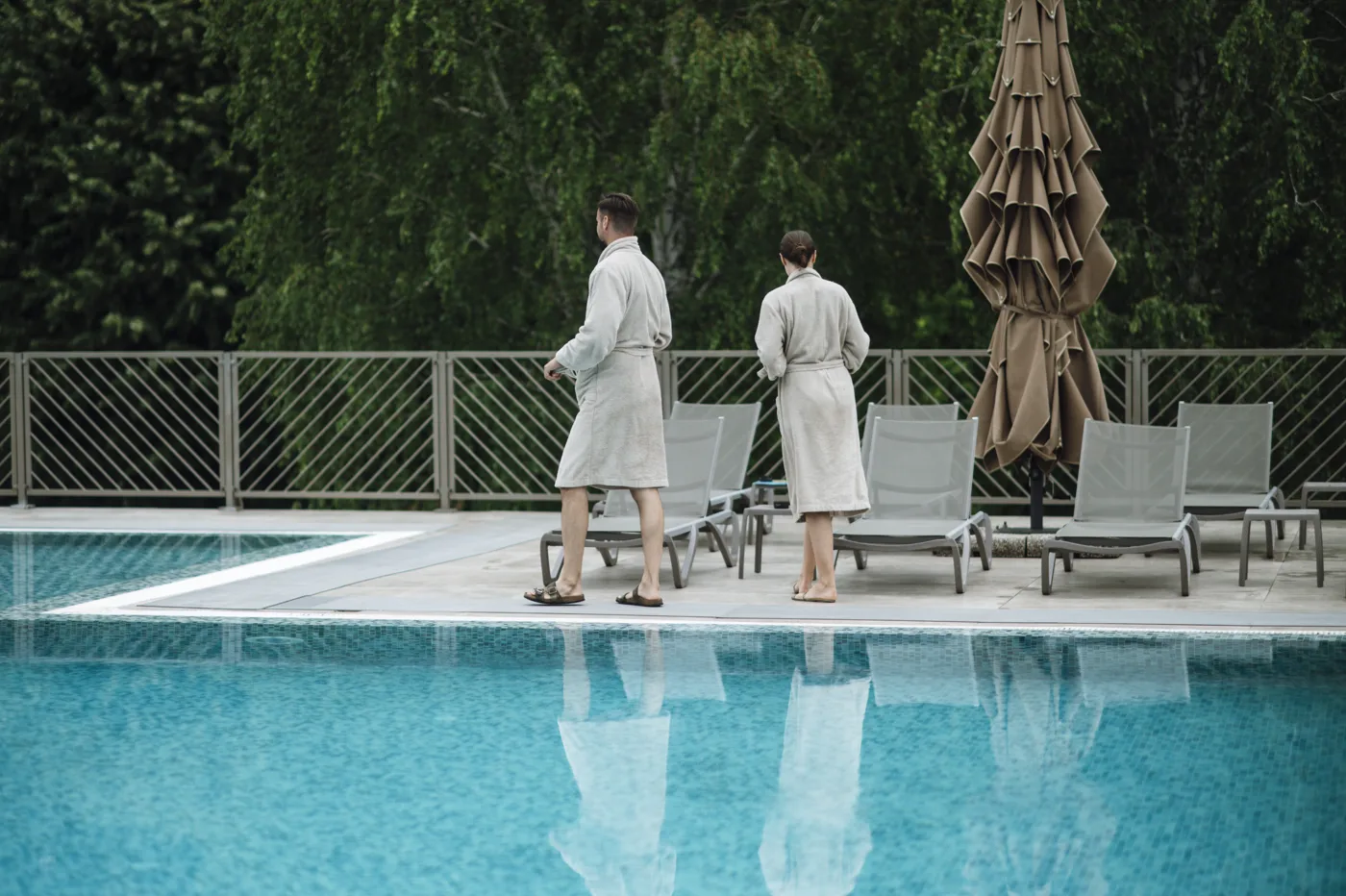
- A bathrobe. Standard kit in German and Austrian complexes for moving between areas.
- A swimming costume anyway. Pools nearly always require one even where saunas forbid it.
- A padlock, for lockers at older public baths.
- No phone in the water areas. Photography bans are near-universal in changing and sauna zones, and are taken seriously.
- Silence. Sauna cabins in the German tradition are quiet rooms. Conversation is the visible tourist mistake.
If you want the same reset without the flight, our guides to wellness retreats near London and solo spa breaks in the UK cover the domestic options, and what to wear at a spa covers the British conventions, which are not the same.
Frequently asked questions
Do you have to be naked in European spas? In the sauna areas of Germany, Austria, Slovenia and much of central Europe, yes: swimming costumes are prohibited in the sauna for hygiene reasons and you wrap in a towel between rounds. Swimming pools almost always require a costume. Iceland and Italy are swimsuit cultures throughout the water areas.
Which European country is best for a first spa break? Hungary for value and atmosphere, or Italy if the textile-free convention is a barrier. Budapest gives you a thermal bath experience and a city break in the same trip, and it is forgiving of first-timers.
Where is the largest spa in Europe? Therme Erding near Munich, which is the largest thermal spa in the world at around 185,000 square metres and holds the largest sauna complex, roughly 12,900 square metres with about 30 saunas.
Do I need to book European thermal baths in advance? For Iceland’s lagoons, always: entry is by timed slot and they sell out. Large German thermal complexes and Budapest’s baths generally admit walk-ins, but booking ahead avoids queues at weekends and school holidays.
What is the difference between a thermal bath and a spa hotel? A thermal bath is a public bathing complex fed by natural hot springs, usually visited for a few hours and shared with everyone else in the city. A spa hotel is a residential stay built around treatments and a private facility. European breaks often combine the two, but they are different experiences and different budgets.
Is a Czech spa town a relaxing holiday? Yes, but not in the way most people expect. The tradition is a drinking cure taken over a week or more, walking the colonnades between springs, with treatments and bathing arranged around it. Go for the architecture, the forest walks and the pace rather than for pool time.
Found a place we’ve missed? Tell us about it.
Back to top