Buying Guides
Spa Hotels in Somerset: Where the Thermal Water Really Is
By the Carefree Retreat team
Updated 2026
Somerset is the only county in Britain where you can bathe in naturally hot water that came out of the ground rather than a boiler, and that single fact should organise how you choose. Most spa hotels in Somerset have a heated pool, a sauna and a steam room, which is a good day out but is the same good day out you could have in Kent or Cheshire. Two places in Bath have something nobody else in the country has. Knowing which is which stops you paying thermal-spa prices for a chlorinated pool.
This guide splits the county three ways: the real thermal water, the large-facility spas around Bath that take day visitors, and the rest of Somerset, with an honest note on who each one will actually let in.
What makes Bath’s water different
The water under Bath fell as rain roughly 10,000 years ago, sank about 2km into the ground where it reached an estimated 69°C, and comes back up through three springs: the Cross Spring, the Hetling Spring and the King’s Spring. It arrives at the surface averaging 45°C, carrying over 42 minerals and trace elements, and there is over a million litres of it every day. Thermae Bath Spa sets out the geology on its waters of Bath page.
That is why the bathing temperature at Bath, around 34°C, feels different from a hotel pool at the same reading. The mineral load, chiefly sulphate, calcium and chloride, changes the density and the feel of the water. It is also why you cannot get it anywhere else: the springs are a fixed geological asset and only two operators have access to them.
The two places you can actually bathe in it
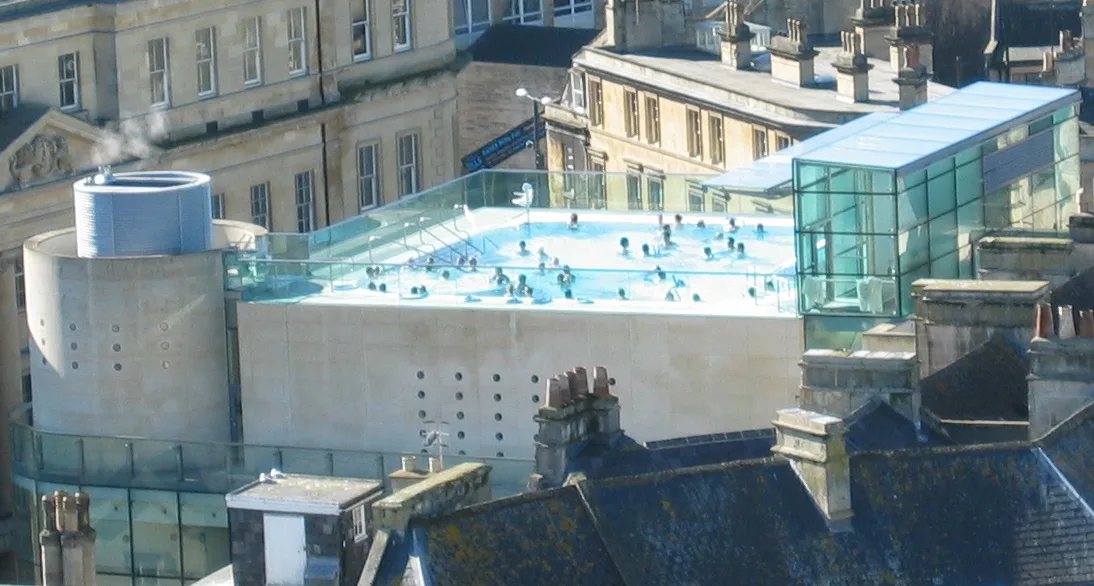
Thermae Bath Spa, in the centre of Bath, is the public one and the only place in Britain where anyone can walk in and bathe in natural thermal water. The draw is the open-air rooftop pool, which is worth timing for dusk, plus the Minerva Bath and a Wellness Suite of steam rooms and an infrared room. The separate Cross Bath, a small circular open-air bath in its own eighteenth-century building a few steps away, is bookable for swim sessions or exclusive use, and it is the better choice if crowds spoil the effect for you.
The rules matter here. It is an adults-only spa: the minimum age of admission is 16, treatments are 18 and over, and proof of age is required on entry. Book ahead, particularly for weekend evenings, because it is the single busiest wellness attraction in the West Country.
The Gainsborough Bath Spa is the other one, and it is the only hotel in Bath with its own geothermal supply. Water is drawn through a 360-foot borehole from the Hetling Spring next door, arrives at around 47°C, and is filtered and regulated before it reaches the pools. Spa Village Bath sits under a glass atrium and runs as a bathing circuit: two natural thermal pools at different temperatures, traditional and infrared saunas, a steam room, an ice alcove and relaxation areas, with 11 treatment rooms alongside.
The important practical point is that you no longer need to book a room. The Gainsborough sells spa days to non-residents, with a Bath House Experience of up to four hours to work through the circuit at your own pace. That makes it the closest thing in Britain to a proper European thermal circuit, and considerably calmer than Thermae on a Saturday.
If you want to sleep in the water rather than visit it, the hotel’s spa rooms have in-bathroom access to the thermal supply, which as far as we can establish is unique in the UK.
The large-facility spas around Bath
These do not have thermal water. What they have is space, and in some cases considerably better treatment facilities than either of the two above.
The Spa at Lucknam Park, at Colerne, is technically over the border in Wiltshire but it is twenty minutes from Bath and it is the biggest name in the area. The facilities are a 20 metre indoor pool, an indoor and outdoor hydrotherapy pool looking onto the arboretum, five thermal cabins, eight therapy rooms, a post-treatment relaxation room and a social lounge. Spa days are sold to non-residents subject to availability, Monday to Saturday, for ages 16 and over. Check before travelling: the spa currently advertises a refurbishment closure in early September, with limited treatments for resident guests only during that window.
Homewood, at Freshford in the Limpley Stoke valley south of Bath, sells spa days to non-residents and is the more relaxed, less formal option of the two. It suits a half-day with lunch rather than a full circuit-and-treatments programme.
Combe Grove, three miles from the centre of Bath in 76 acres at Monkton Combe, needs a clear warning attached. It is a genuinely good facility, with a Nordic-inspired indoor heated pool, a seasonal outdoor heated pool, a sensory sauna and steam room, tennis and a gym. But it has repositioned as a metabolic health centre, owned by the charitable trust The Elmhurst Foundation, and it runs on health programmes and local membership rather than on pamper days. Go for a structured wellbeing programme or to join. Do not go expecting a robe-and-slippers afternoon.
The rest of Somerset
Once you leave the Bath corner, Somerset thins out quickly, and the honest position is that the county’s reputation rests on Bath rather than on a spread of good spas.
The Newt in Somerset, at Bruton, is the standout property and the most restricted. The spa has a hydrotherapy pool, a marble steam room, a garden-view sauna, a halotherapy room, a Turkish-style hammam and a light-filled lounge, with yoga, pilates and gym programming alongside. The site is clear that hotel guests can book treatments at leisure. It publishes no open day-visitor route to the spa, so treat it as somewhere you go by staying, not somewhere you drive to for the afternoon.
West Somerset and the Quantocks have the county’s traditional health-farm-style properties near Taunton, which sell straightforward day packages with a heated indoor pool, sauna, steam and treatments. They are the option if you want a Somerset spa day without driving into Bath, and they are honest about what they are.
If the appeal is the water rather than Somerset specifically, it is worth reading our spa days in Oxford and spa days in Kent pages, both of which cover a similar drive from London.
Choosing between them
- You want the thing you cannot get elsewhere. Thermae Bath Spa for the rooftop pool, or the Cross Bath if you want it quiet. Book an evening session.
- You want the thermal water without the crowd. The Gainsborough’s Bath House Experience. Four hours, a proper circuit, non-residents welcome.
- You want treatments and space, and do not care about geology. Lucknam Park.
- You want a half day with lunch. Homewood.
- You want to change something about your health. Combe Grove, on a programme.
- You want a weekend rather than a day. The Newt, and stay.
A practical note that applies to all of them: Bath’s parking is difficult and expensive, and Thermae Bath Spa has none of its own. The park and ride is the sensible approach, and it closes earlier than the spa does, which catches people out on evening sessions.
For the wider question of a day versus an overnight, our overnight spa breaks guide covers the trade-off, and what to wear to a spa day answers the question everyone has about the rooftop pool in February.
Frequently asked questions
Which spa hotels in Somerset have real thermal water? Only The Gainsborough Bath Spa, which draws from the Hetling Spring through its own 360-foot borehole. Thermae Bath Spa also uses the natural springs but is a public spa rather than a hotel. Every other spa in the county heats ordinary water.
Can you visit the Gainsborough spa without staying at the hotel? Yes. It sells spa days to non-residents that include a Bath House Experience of up to four hours, giving access to the thermal circuit of two natural pools, saunas, steam room and ice alcove.
How hot is the water at Thermae Bath Spa? The springs arrive at the surface averaging 45°C, and the water is brought to a bathing temperature of about 34°C. The source water is an estimated 69°C two kilometres underground before it rises.
Is there an age limit at Thermae Bath Spa? Yes. It is adults only, with a minimum admission age of 16 and a minimum age of 18 for treatments. Proof of age is required on entry, so take ID for anyone who looks close to the line.
What is the best spa day near Bath if you want a big pool? Lucknam Park at Colerne, which has a 20 metre indoor pool plus an indoor and outdoor hydrotherapy pool and five thermal cabins. Spa days run Monday to Saturday for ages 16 and over, subject to availability.
Can you do a spa day at The Newt in Somerset? Not through any published route. The spa, with its hydrotherapy pool, hammam, halotherapy room and saunas, is presented as something hotel guests book at leisure. Plan a stay rather than a day trip.
When is the quietest time to visit Bath’s thermal spas? Weekday mornings and late evening sessions. Weekends and school holidays fill the rooftop pool at Thermae to the point where the view is the only thing you get out of it. The Cross Bath and the Gainsborough’s circuit are the calmer alternatives at any time.
Found a place we’ve missed? Tell us about it.
Back to top