Detox and Fasting Retreats
Juice vs Water Fasting: Which Retreat Is Safer to Book?
By the Carefree Retreat team
Updated 2026
Juice vs water fasting comes down to how much risk and discomfort you are signing up for. On a juice fast you still take in some sugar, vitamins and potassium, so most healthy adults get through a week feeling tired and hungry but steady. On a water fast you take in nothing but water and herbal tea, so you lose salts faster, feel the lows harder, and the first meal afterwards needs real care. For a first fasting retreat in the UK, book a juice week. Choose water only if you are healthy, have fasted before, have spoken to your GP, and the retreat screens you and watches you through it.
This page sets out what each kind of fast does, what the two largest studies of supervised fasting found, who should not fast at all, and what to ask a retreat before you pay. Our juice fasting retreats in the UK page compares five places that run juice weeks, with dates.
Juice vs water fasting at a glance
| Juice fast | Water fast | |
|---|---|---|
| What you take in | Fresh vegetable and fruit juices, water, herbal tea; some retreats add broth | Water and herbal tea only |
| Calories | Some, depending on how much juice; the German Buchinger method allows 200 to 250 kcal a day of juice and broth | None |
| Salts and minerals | Some potassium and other minerals from the juice | Lost through the urine and not replaced, unless the retreat adds them |
| How it feels | Hungry and low on energy for a day or two, then steadier | Harder: more dizziness, headaches and emotional lows, especially from day two |
| Breaking the fast | A day or two of light food | Needs a planned return to food, longer after a longer fast |
| Suits | First-timers and most healthy adults | Experienced fasters, with medical screening and supervision |
| UK options | Several, from weekends to a fortnight | Few; Sura Detox in Devon lets you switch to water day by day |
What happens in your body
For the first day of any fast your body runs mostly on stored glucose. As that runs down it burns more fat and makes ketones, which the brain can use for fuel. A water fast pushes you into that state fastest and furthest. Juice slows it a little, because the sugar in the juice is fuel, but at a few hundred calories a day you are still in a deep deficit.
The difference that matters most for safety is salts. Fasting makes your kidneys flush out water, sodium and potassium. On juice you replace some of that potassium; on water you replace none of it. That is why light-headedness when you stand up, cramps and palpitations are more common on water fasts, and why a good water fasting retreat checks blood pressure daily and knows what to do when someone feels faint.
Neither fast detoxes you. Your liver, kidneys and gut clear waste every day, and the British Dietetic Association says no juice or diet does it better. Much of the weight you lose in the first few days is water and stored glycogen, which comes back when you eat normally. Our UK detox retreats guide goes through what a fasting week can and cannot do.
What the research found
There is far less research on fasting retreats than the marketing suggests, but two large studies from medical clinics are worth knowing, because they show what fasting looks like when it is done carefully.
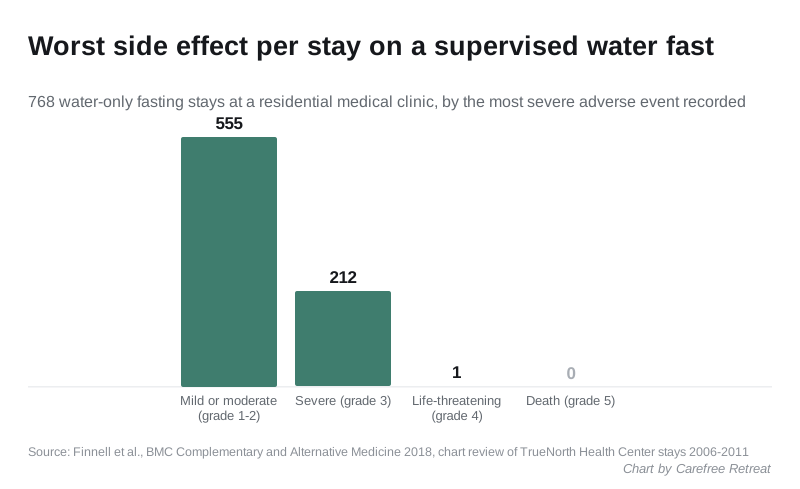
Water-only fasting, United States. A 2018 chart review in BMC Complementary and Alternative Medicine looked at 768 water-only fasting stays at TrueNorth Health Center, a residential medical clinic in California, between 2006 and 2011. Everyone was at least 21, fasted for two days or more, and then had a refeeding period half as long as the fast. In 555 stays the worst side effect was mild or moderate, and most side effects overall were known reactions to fasting. In 212 stays, more than one in four, someone had a severe (grade 3) event. One stay had a life-threatening (grade 4) event, there were two serious adverse events in total, and nobody died. The authors concluded their protocol can be used safely in a medical setting. Note the last three words: those fasters had doctors and daily checks.
Juice and broth fasting, Germany. A 2019 study in PLOS ONE followed 1,422 people at the Buchinger Wilhelmi clinic who fasted for 4 to 21 days on 200 to 250 kcal a day of juice and vegetable broth, with gentle exercise. They lost weight and waist size, and their blood pressure fell, and the authors reported the regime was well tolerated. This is the closest published evidence to a juice retreat, but it was in a clinic with medical staff, not a farmhouse.
Neither study compared juice with water directly, so no one can tell you one gives better health results. What they do show is that a long fast is a medical event, and the deeper the fast, the more it needs someone qualified watching.
Who should not fast
Talk to your GP before any fasting retreat if you take regular medication or have a long-term condition. Do not fast at all, on juice or water, without medical advice if you:
- are pregnant or breastfeeding;
- are under 18;
- have, or have had, an eating disorder;
- are underweight (a BMI under 18.5);
- have type 1 diabetes, or take insulin or tablets that lower blood sugar;
- have kidney disease, gout, or heart rhythm problems;
- take diuretics or blood pressure medication, which interact with salt and fluid loss.
The refeeding risk is real. NICE’s guidance on nutrition support counts little or no food for more than five days as one of the factors that put someone at high risk of refeeding problems, a dangerous shift in salts when eating starts again. A healthy adult on a week-long water fast is not the patient that guidance was written for, but it is why any fast of five days or more should end with a planned, gradual return to food, and why the retreat should run that part as carefully as the fast itself.
Which retreats offer which
Most UK fasting retreats are juice retreats. On our juice fasting retreats list, The Cotswolds Juice Retreat near Stroud runs six-night juice weeks, Jiva Healing adds broth and barley grass, La Crisalida in mid Wales takes guests any day of the year, and The Glass House in Essex mixes juice with soup in the evening.
Water fasting in the UK is rarer. Sura Detox in Devon, which describes itself as Britain’s pioneer in juice and water fasting, lets guests choose juice or water day by day through its week-long retreats. Its own page on water fasting says it presents the option “with some caution, as it is not for everyone”, and that around half of each group now moves to a water fast during the week. Sura’s package also includes colonic irrigation; there is no good evidence it adds any health benefit, so treat it as optional.
Abroad, the Buchinger Wilhelmi clinics in Überlingen, Germany, and Marbella, Spain, run the juice and broth fasts from the German study, with doctors on site. If you want a medically supervised fast, that is the model to look for. Our best detox retreats page covers gentler UK options that do not involve fasting at all.
Questions to ask before you book
- Do you ask for a health questionnaire, and will you contact my GP if something on it worries you?
- Is anyone with a medical or nursing qualification on site, or on call, during the fast?
- Do you check blood pressure or weight daily, and what happens if I feel faint?
- On a water fast, do you give salts or broth if someone needs them?
- How do you break the fast, and for how many days?
- What is your refund policy if I have to stop for medical reasons? Our page on travel insurance exclusions for retreats explains why that matters.
A retreat that cannot answer the first three clearly should not be running water fasts.
Which should you choose?
Choose a juice fast if this is your first fasting retreat, you want to keep up gentle walks and yoga, you take any regular medication, or you mainly want a week off alcohol, caffeine and sugar. It is the safer choice and gives you most of what people value in a fasting week: rest, routine and a reset in how you eat.
Choose a water fast only if you are healthy, have done a juice fast before, your GP has no objection, and the retreat screens you, checks on you every day and plans the return to food. Book it for the experience of going without, not for a bigger health payoff, because there is no evidence of one compared with juice.
If what you really want is to lose weight and keep it off, a fast of either kind is a poor tool. Our weight loss retreats page covers programmes built around eating, exercise and habits instead.
Frequently asked questions
Is juice fasting or water fasting better? Neither has been shown to give better health results, because no study has compared them directly. Water fasting is harder and carries more risk from salt loss and refeeding, so juice fasting is the better choice for most people, especially first-timers.
Is water fasting safe? For healthy adults, in a medical setting, mostly. In the largest study, 768 supervised water-fasting stays, most side effects were mild, but more than one stay in four had a severe event. Without screening and supervision, the risk is higher.
How long should a first fast be? Most UK juice retreats run five or six nights, which is enough for a first time. NICE treats little or no food for more than five days as a refeeding risk factor, so longer fasts need a planned return to food.
Do you lose more weight on a water fast? You usually lose more on the scales, but much of it is water and stored glycogen, which returns when you eat normally. Fat loss over a week is limited either way.
Can I fast if I take medication? Speak to your GP first. Diabetes medication, diuretics and blood pressure tablets can all become risky when you stop eating, and doses may need changing.
Which UK retreats offer water fasting? Few do. Sura Detox in Devon lets guests switch between juice and water each day, and says about half of each group moves to water. Most other UK fasting retreats are juice-only.
Found a place we’ve missed? Tell us about it.
Back to top