Buying Guides
GHIC Card for Europe Travel: What It Won't Cover on a Retreat
By the Carefree Retreat team
Updated 2026
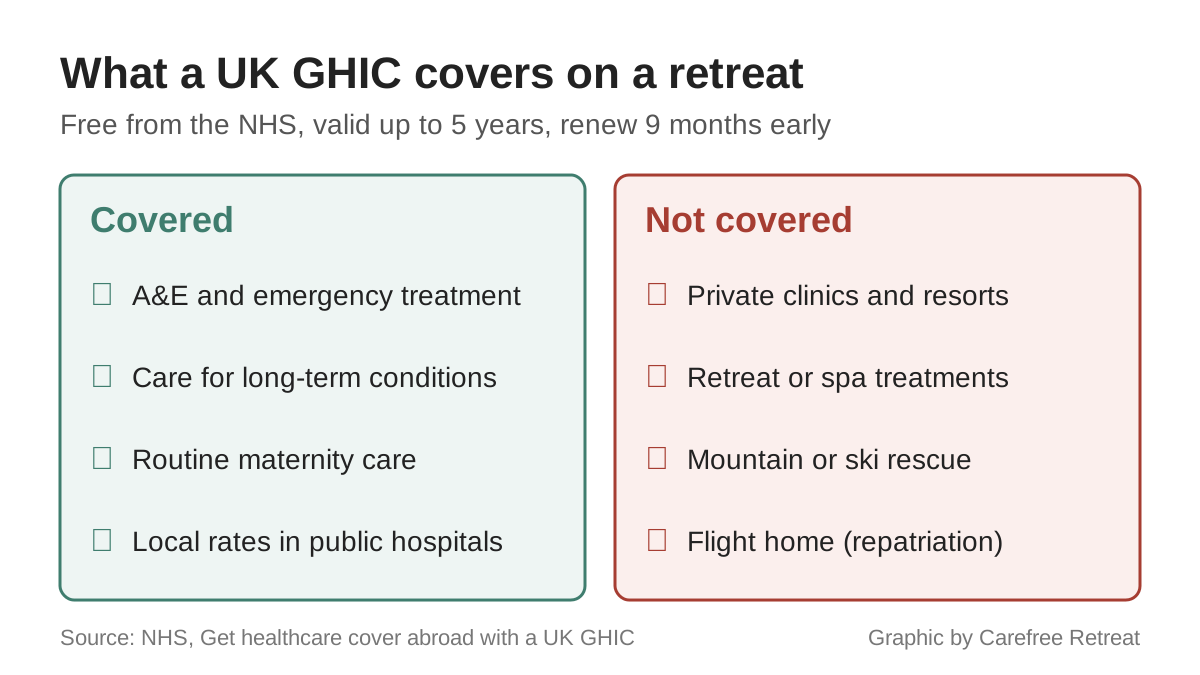
A GHIC card for Europe travel, the UK Global Health Insurance Card, lets you use a country’s state healthcare on the same terms as a local resident when something goes wrong that cannot wait until you are home. It is free, lasts up to five years and comes from the NHS. It is also the most misunderstood document in a retreat-goer’s bag, because the places most retreats send you to, a private clinic, a wellness resort, a mountain trail, sit almost entirely outside what it pays for.
Everything on this page is taken from the NHS page on applying for and using a UK GHIC, checked on 1 October 2026.
The short version
- It costs nothing. Apply only through the NHS website. The NHS warns that unofficial sites “may charge you a fee to apply”.
- It is valid for up to five years, and you can apply for a replacement up to nine months before the current one expires.
- Allow three weeks or more. You get an email within 24 hours saying whether the application is approved; the card then arrives by post, usually within 15 working days of approval.
- It covers state healthcare only, and only care that is medically necessary during the trip.
- It does not replace travel insurance. The NHS itself advises carrying both.
What the card actually pays for
The card gets you “state healthcare that cannot reasonably wait until you come back to the UK”. The NHS gives three examples:
- emergency treatment and visits to A&E
- treatment or routine care for long-term or pre-existing conditions
- routine maternity care, provided you are not travelling in order to give birth
Two rules sit behind that list and catch people out.
The doctor abroad decides what is necessary. Whether treatment counts as medically necessary is decided by the healthcare provider in the country you are visiting, not by you or the NHS.
You pay what a local would pay. Not all state healthcare in Europe is free at the point of use. If residents pay a contribution, you do too. Some countries ask you to pay the whole bill upfront and claim back afterwards; you can recover the difference between the bill and the local patient contribution, but that contribution itself is not refundable.
Some treatments, such as kidney dialysis or chemotherapy, need to be arranged in advance with a provider in the country you are visiting, because capacity is not guaranteed. If you depend on regular treatment and are booking a week away, sort this before you pay the retreat deposit.
Where a retreat falls outside it
This is the part the NHS page states plainly and most retreat marketing does not. The card does not cover:
- Treatment in a private medical facility. Many of the best-known European wellness destinations are private clinics or private medical spas. If you fall ill at one, the in-house doctor is private healthcare. To use the card you need to go to a public hospital or state-registered provider, and the NHS advises you to make sure you are being treated by a public provider, not a private one.
- Anything you went for. Detox programmes, IV drips, medical check-ups, spa cures and the treatments on a retreat menu are not “medically necessary healthcare”. The card pays for none of it. If a medical retreat such as SHA in Spain is on your list, it is a private purchase from start to finish.
- Mountain or ski rescue. Walking, trail-running and alpine yoga retreats are popular for a reason, but a rescue from a hillside is excluded.
- Getting you home. Medical repatriation, being flown back to the UK, is not covered at any price.
That last exclusion is the expensive one. A broken ankle on a Mallorcan hiking retreat can be treated in a Spanish public hospital under the card; the stretcher-friendly flight home cannot.
Where you can use it
A UK GHIC works in:
- every country in the European Economic Area, which is the 27 EU states plus Iceland, Liechtenstein and Norway
- Montenegro, Australia, Jersey, Guernsey and the Isle of Man, and St Helena, Tristan and Ascension
- Switzerland, with conditions. You can use it there if you are a British national, a Swiss national, an EU citizen, a refugee or stateless person, or a family member of one of those.
Outside that list the card is not accepted. On a retreat in Bali or Costa Rica, for example, you pay for all treatment yourself unless your insurer does. In Montenegro, emergency treatment is free with a UK passport, but prescribed medicines and other treatment are charged.
The card and travel insurance together
The NHS position is that you should have a UK GHIC and private travel and medical insurance for the length of the trip. The two do different jobs. The card gets you public treatment at local rates. Insurance pays for what the card does not: repatriation, rescue, private treatment, cancellation and lost luggage.
Holding a GHIC is worth telling your insurer about. Some policies waive the excess on a medical claim if you used the card in a public hospital, because it reduces what they pay; check yours.
For an activity retreat, read the activity list in the policy before you book. Yoga and meditation are rarely an issue. Surfing, canyoning, high-altitude trekking and anything involving horses often sit in an extra-cost category or are excluded. The government’s foreign travel insurance guidance covers what to look for, including declaring pre-existing conditions.
Renewing before a booked retreat
If you book a retreat months ahead, look at the expiry date on your card the same day. Because you can apply up to nine months early, there is no reason to travel on a card that runs out mid-trip.
- Old EHICs still work until the expiry date printed on them, then need replacing with a GHIC.
- Every family member needs their own card. You can add a spouse, civil partner and children in the same application, after entering your own details.
- You need your full name, address, date of birth and National Insurance number, plus a Health and Care number if you are from Northern Ireland.
If the card has not arrived when you fly, or you leave it at home, you can apply for a Provisional Replacement Certificate through NHS Overseas Healthcare Services. It gives the same cover as the card. Without a card or certificate, you pay the full bill and have to claim afterwards.
If you are charged abroad
Keep every receipt, the invoice, proof that the treatment was state-provided and any discharge papers. To reclaim costs the card should have covered, fill in the refund claim form and send it to NHS Overseas Healthcare Services with those documents. If your insurer paid, it may be reimbursed instead.
Before you travel, it is also worth checking the passport rules for an EU retreat and whether your booking is ATOL or package protected. For the spa towns where the card and private treatment meet most often, see our guide to spa breaks in Europe.
Frequently asked questions
Is the GHIC card free? Yes. A UK GHIC is free from the NHS website and lasts up to five years. Sites that charge a fee are unofficial; the NHS advises avoiding them.
How long does a GHIC take to arrive? The NHS emails within 24 hours to say whether the application has been approved. Once approved, the card should arrive by post within 15 working days. If it has not arrived before you travel, you can get a Provisional Replacement Certificate for temporary cover.
When can I renew my GHIC? Up to nine months before the current card expires. An old EHIC can be used until its expiry date and then needs replacing with a GHIC.
Does a GHIC cover treatment at a private clinic or wellness resort? No. The card covers state healthcare only. Treatment in a private medical facility, and anything you travelled for, such as a detox programme or spa treatment, is not covered.
Do I still need travel insurance if I have a GHIC? Yes. The NHS says the card is not a replacement for travel insurance. It does not pay for medical repatriation, mountain or ski rescue, or private treatment, and it does nothing for cancellations or lost bags.
Can I use a GHIC in Switzerland and Norway? In Norway, yes, as it is in the European Economic Area. In Switzerland, yes if you are a British national, Swiss national, EU citizen, refugee or stateless person, or a family member of one.
Found a place we’ve missed? Tell us about it.
Back to top