Spa Breaks and Wellness Hotels
Thermal Spas in the UK: Only 4 Use Natural Spring Water
By the Carefree Retreat team
Updated 2026
Thermal spas in the UK are rarer than the word suggests. Hundreds of spas sell a “thermal suite” or “thermal journey”, but that means saunas, steam rooms and heated pools, filled from the mains and warmed by a boiler. Only a handful of places in Britain let you bathe in water that comes out of the ground from a natural spring, and only in one city, Bath, is that water naturally hot.
This page sorts the real thing from the marketing. It covers the four places where the water in the pool is spring water, what each one feels like, and the historic spa towns where you can no longer bathe at all.
The four places with natural spring water
| Spa | Where | The water | Can you visit for the day? |
|---|---|---|---|
| Thermae Bath Spa | Bath, Somerset | Hot springs, about 45°C at source | Yes, public spa, 16 and over |
| Spa Village Bath, The Gainsborough | Bath, Somerset | Same hot springs, via the hotel’s own borehole | Yes, spa days sold to non-residents |
| Buxton Crescent (Champneys) | Buxton, Derbyshire | Buxton mineral water, heated for the thermal pool | Yes, Champneys spa days |
| New Bath Hotel lido | Matlock Bath, Derbyshire | Naturally warm spring water, outdoor | Check with the hotel |
Thermae Bath Spa, Bath
This is the only place in Britain where anyone can walk in and bathe in naturally hot water. Bath’s springs rise at an average of 45°C, carrying more than 40 minerals, and Thermae cools the water to a comfortable bathing temperature. It describes itself as “Britain’s original natural thermal spa”; session times and bookings are on the Thermae Bath Spa website.
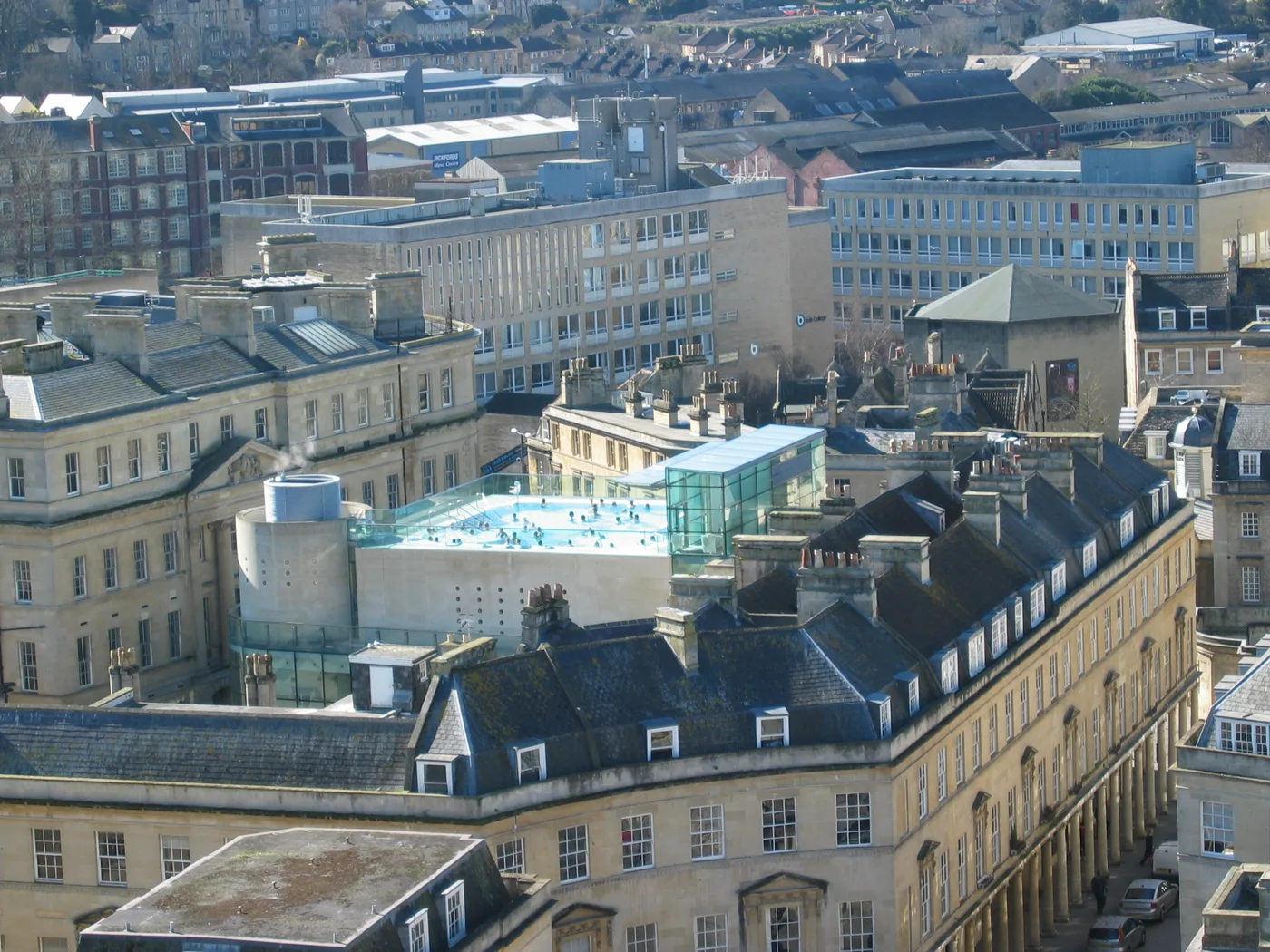
The draw is the open-air rooftop pool, with views over the city’s roofs and the Abbey, best at dusk. Inside there is the Minerva Bath and a Wellness Suite of steam rooms. A few steps away, the small open-air Cross Bath is bookable on its own and is far calmer.
Rules worth knowing before you book: the minimum age for admission is 16, and 18 for treatments. Weekend and evening sessions sell out, and the rooftop pool can get crowded at peak times. There is no parking of its own. Our Bath and Somerset spa days page goes deeper on the springs and on choosing between the two Bath spas.
Spa Village Bath at The Gainsborough
The Gainsborough Bath Spa hotel draws the same spring water through its own borehole, which makes it the only hotel in Britain with natural thermal water in its spa. Spa Village Bath, under a glass roof, runs as a circuit: two thermal pools at different temperatures, saunas, a steam room and an ice alcove.
You do not need to stay. The hotel sells spa days to non-residents, and the circuit is noticeably quieter than Thermae on a Saturday. If you want Bath’s water without the crowd, this is the one to book.
Buxton Crescent, Derbyshire
Buxton has been a spa town since the Romans, and its spring water emerges at a steady temperature of about 27°C, high in minerals including magnesium. After decades closed, the Grade I listed Crescent reopened as a spa hotel in 2020. Champneys bought the hotel business in November 2025 and now runs it as a Champneys spa.
Its centrepiece is a restored Victorian thermal pool, which Champneys describes as “filled with heated Buxton Mineral Water”. There are three pools in total. Champneys sells spa days, mornings, afternoons and evenings, so you can visit without staying the night.
Be clear on what you are getting: the water is natural mineral spring water, but at 27°C at source it is warmed for bathing. It is a real spring-water spa, not a naturally hot one.
New Bath Hotel lido, Matlock Bath
The open-air lido at the New Bath Hotel, now part of Radisson Individuals, is fed by one of Matlock Bath’s warm springs. Visit Peak District calls it the only English lido heated by spring water, with temperatures of roughly 15°C in winter and 23°C in summer. That is a bracing outdoor swim, not a hot soak. It is chlorine-free and surrounded by the hotel’s gardens. Check access with the hotel before travelling, because day-visitor arrangements and seasonal closures change. Our outdoor spas page lists heated outdoor pools if you want the open air with more warmth.
Spa towns where you cannot bathe in the water
Several famous spa towns are named after their waters but no longer offer spring-water bathing. Worth knowing before you book a break on the name alone:
- Harrogate, North Yorkshire. The Victorian Turkish Baths are open and well worth a session, but they use ordinary heated water. The famous sulphur wells are for looking at and, historically, drinking. Our Yorkshire spa days page covers them.
- Royal Leamington Spa, Warwickshire. The Royal Pump Rooms are now a museum, library and café.
- Droitwich Spa, Worcestershire. Built on brine springs. The old brine baths have closed; our Worcestershire spa days page lists the spas operating today.
- Cheltenham, Gloucestershire. The Pittville Pump Room survives as a venue, not a spa.
Thermal suites: what most “thermal spas” really are
Most UK spas use “thermal” to describe a circuit of heat and cold: sauna, steam room, salt or herbal rooms, an experience shower, an ice fountain and a hot tub or hydrotherapy pool. Done well, these are excellent. Hoar Cross Hall, Titanic Spa and Center Parcs’ Aqua Sana all have big thermal circuits, and our Aqua Sana guide explains how theirs works.
If what you want is the heat and the ritual, a good thermal suite gives you that anywhere in the country. If what you want is to sit in water that came out of the ground, it is Bath, Buxton or Matlock Bath. Our list of the best spa hotels in the UK covers the best thermal suites by region.
Frequently asked questions
Are there any natural thermal spas in the UK? Yes, but only in Bath are the springs naturally hot. Thermae Bath Spa and Spa Village Bath at The Gainsborough both use water from Bath’s hot springs. Buxton Crescent uses natural mineral water that is heated for bathing, and the lido at Matlock Bath is fed by a naturally warm spring.
How hot is the water at Thermae Bath Spa? Bath’s springs rise at an average of about 45°C. The spa cools the water to a comfortable bathing temperature, a little above body heat.
Can children go to Thermae Bath Spa? No. The minimum age for admission is 16, and treatments are for over-18s only. Proof of age can be asked for at the door.
Can I visit Buxton Crescent spa without staying? Yes. Champneys, which took over the hotel in November 2025, sells spa days, mornings, afternoons and evenings at Buxton Crescent. Check the current packages on Champneys’ site before booking.
What is the difference between a thermal spa and a thermal suite? A thermal spa, strictly, uses natural spring water. A thermal suite is a circuit of saunas, steam rooms, cold showers and hot tubs using ordinary heated water. Most UK spas advertising “thermal” experiences mean the second.
Which is better, Thermae Bath Spa or The Gainsborough? Thermae has the rooftop pool and the view; The Gainsborough has the calmer, more private circuit. Choose Thermae for the experience of the city, and The Gainsborough if you want quiet.
Found a place we’ve missed? Tell us about it.
Back to top