Spa Breaks and Wellness Hotels
Spa Break vs Wellness Retreat: The 6 Differences That Matter
By the Carefree Retreat team
Updated 2026
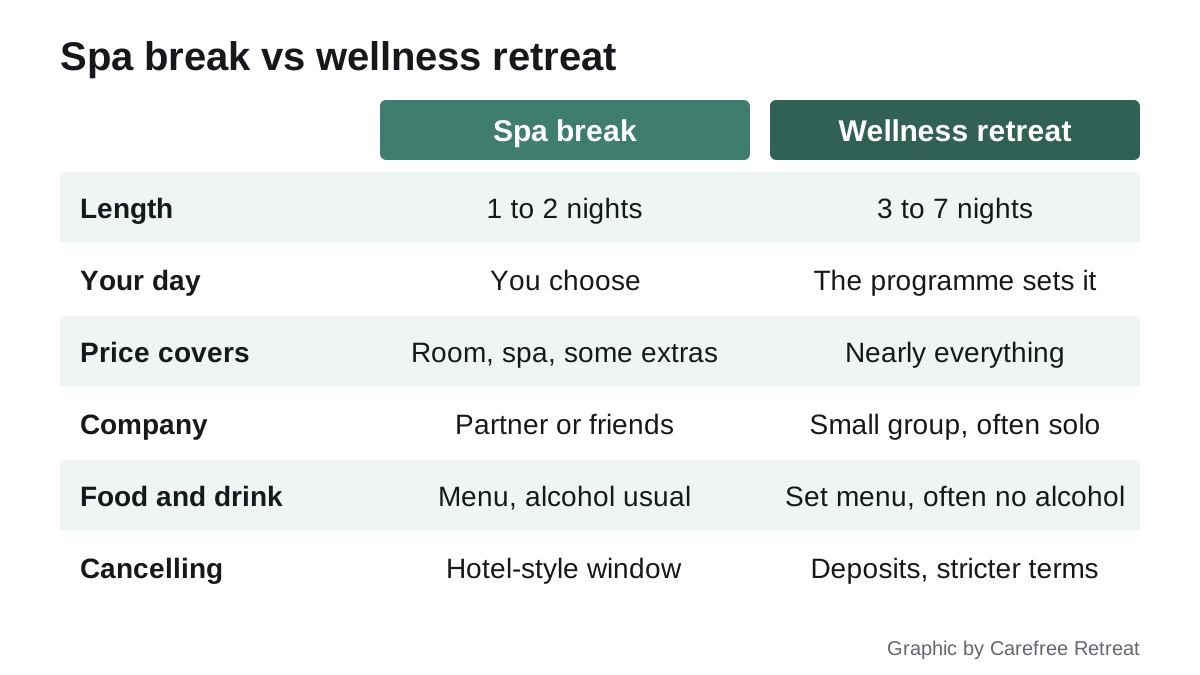
The difference between a spa break vs wellness retreat is not the pool, the robe or even the price. It is who decides what you do all day. On a spa break you book a room with spa access, then choose your own treatments, meals and hours by the pool. On a wellness retreat the programme decides for you: set meals, set sessions, set times, and often a small group you have never met. Both can be called “wellness”, and plenty of places sell both, so the label on the website tells you very little.
This page sets out the six differences that actually change your experience, with UK examples we have already covered in detail, and a simple way to choose.
The short version
| Spa break | Wellness retreat | |
|---|---|---|
| Typical length | One or two nights | Three to seven nights, often fixed dates |
| Who plans the day | You | The programme |
| What is included | Room, spa access, usually one or two treatments and some meals | Nearly everything: meals, classes, activities, often treatments |
| Who you are with | Your partner or friends, among hotel guests | Often a small group, many people come alone |
| Food and drink | Restaurant or set spa menu, alcohol usually available | Set menu, often lighter, sometimes no alcohol or caffeine |
| Booking terms | Hotel-style: cancel within a set window | Deposits, balance weeks ahead, stricter cancellation |
If you want rest on your own terms, book a spa break. If you want to change something, such as sleep, stress, fitness or habits, and you know you will not do it unless someone else sets the timetable, a retreat is the better fit.
1. Who decides what you do
This is the real dividing line. At a spa hotel such as Ragdale Hall in Leicestershire you arrive in the afternoon, have the run of the pools and thermal rooms, and book whatever treatments you like on top of the package. Nobody minds if you spend the whole stay in a robe.
At a fixed-programme retreat the day is set. Yeotown in North Devon runs one programme, Wednesday to Sunday, with hikes, yoga, fitness, breathwork and a massage at the end of each full day all chosen by the team. It does not even share the timetable in advance. The point is that you make no decisions all week.
Some places sit in the middle. The Glass House Retreat in Essex offers a daily timetable of classes, walks and talks, but nothing is compulsory: you pick what you want, and you can stay one night as a spa break or up to 21 nights as a retreat. If a place calls itself a retreat, check whether the sessions are a programme or a menu.
2. How long you go for
Spa breaks are short by design: one night, sometimes two, and our guide to overnight spa breaks shows why the second day of facilities is the part worth paying for. Retreats usually need longer to work, because the first day goes on arriving, switching off and getting used to the routine. Many UK retreats run three to five nights, and many only start on set days of the week. Our retreat length planner helps you match the length to what you want out of it.
3. What the price covers
A spa break price is a room price with extras. The package usually includes spa access, breakfast, sometimes dinner and one treatment; additional treatments, drinks and classes are added to the bill. It looks cheaper per night, and for a lazy weekend it is.
A retreat rate covers almost everything: all meals, all sessions, often several treatments, and sometimes transfers or walks with guides. It looks much dearer per night, but you are comparing different things. The fair comparison is what you would spend at a spa hotel to get the same number of treatments, classes and meals over the same nights. Our wellness retreat cost calculator lets you run that sum.
4. Who else is there
Spa breaks are mostly couples and groups of friends, and many hotels set an age limit: Ragdale Hall is 16 and over across the whole property. You will share the pool with other guests but you will not get to know them.
Retreats are built around a group, often small. Yeotown takes a maximum of 12 guests a week, and many retreat guests come alone. Eating together and doing every session together is part of the design. That is a draw for some people and the opposite for others. If you are going solo and want company, a retreat makes that easy; if you want to be left alone, look at our solo spa breaks instead.
5. Food, drink and phones
At a spa hotel you eat in the restaurant, choose from a menu and can usually order a glass of wine. Phones are often banned in the spa areas themselves (Ragdale Hall’s spa is a phone and camera-free zone) but not in your room.
Retreats tend to have firmer rules. Yeotown serves no coffee, and many retreats are alcohol-free or plant-based. Do not rely on older reviews for this: the Glass House was widely described as vegan and alcohol-free, but its 2026 menus include chicken, fish and wine. If a strict detox is the reason you are booking, ask the retreat directly what is served this year.
6. Booking and cancellation terms
This is where people get caught out. A spa hotel usually works like any hotel: a deposit or full payment, and a cancellation window after which you lose some or all of it.
Retreats are smaller businesses running fixed dates, so their terms are stricter. At Yeotown the 25% deposit is non-refundable, the balance is due eight weeks before arrival, and inside 30 days there is no refund at all, though you can transfer your place to someone else. Read the payment terms page before you pay, and buy travel insurance that covers cancellation. Our guide to cancelling a retreat or spa break explains where consumer law helps and where it does not. For a retreat abroad sold with flights, check for ATOL protection.
Which should you book?
Book a spa break if:
- You want a treat or a rest, not a change of habits.
- You are going as a couple or with friends and want time together.
- You have one or two nights.
- You want to choose your own treatments and eat what you like.
Book a wellness retreat if:
- You are tired in a way a weekend will not fix, and need someone else to run the day. Our list of UK retreats for burnout starts there.
- You want to come home doing something differently: sleeping better, moving more, drinking less.
- You are happy to be in a group, or are going alone and would like company.
- You can give it three nights or more.
Look at a hybrid if you cannot decide. A place like the Glass House, or a destination health spa with a daily class timetable, lets you take as much or as little structure as you want. Our UK spa breaks guide and our ranking of the best wellness retreats in the UK cover both ends.
Whichever you book, the treatments are only as good as the person giving them. Our page on spa therapist registration explains how to check a therapist on the CNHC register, the UK’s government-backed register for complementary therapists.
Frequently asked questions
What is the difference between a spa break and a wellness retreat? A spa break is a hotel stay with spa access where you choose what to do. A wellness retreat is a planned programme of sessions, meals and activities, usually over several nights and often in a small group. The structure is the main difference, not the facilities.
Is a wellness retreat worth the extra cost? It can be, because the rate covers nearly everything. Compare it with what a spa hotel would charge for the same meals, treatments and classes over the same number of nights, rather than the headline room price.
Can you go on a wellness retreat alone? Yes, and many guests do. Retreats are designed around group sessions and shared meals, so they suit solo travellers who would like some company.
How long should a wellness retreat be? Three to five nights is a common length in the UK, and it gives you time to settle in before the routine starts to help. A single night is closer to a spa break whatever it is called.
Do wellness retreats allow alcohol? Some do and some do not, and it changes. Many fixed-programme retreats are alcohol and caffeine-free, while others now serve wine. Check the current menu with the retreat before you book rather than relying on older reviews.
Can I cancel a wellness retreat? Usually only on the retreat’s own terms, which are often stricter than a hotel’s: non-refundable deposits and no refunds close to the date are common. Read the payment terms and take out travel insurance with cancellation cover.
Found a place we’ve missed? Tell us about it.
Back to top